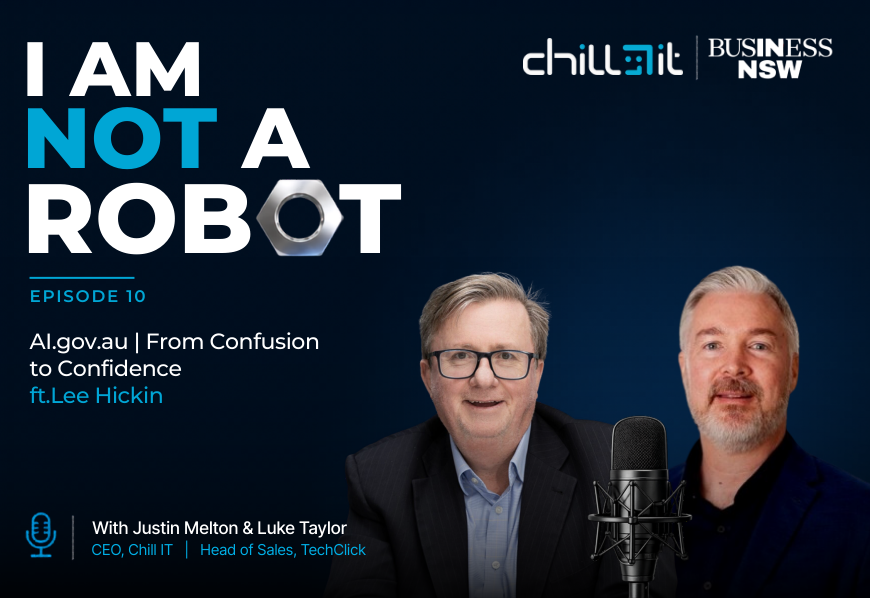
AI for Small Business: Turning Opportunity into Action
Artificial intelligence can feel overwhelming for small businesses. Between new tools, constant headlines and concerns about getting it wrong, knowing where to begin can be difficult. In this episode of I Am Not a Robot, Justin Melton and Luke Taylor are joined by Lee Hicken, Executive Director of the National AI Centre, to cut through the noise and explore what AI actually means for Australian businesses. Lee’s message is clear: AI does not need to be complicated. The opportunity is to understand where it can solve real problems, start using it practically and build confidence through experience.
For many small businesses, the best place to start is with the everyday tasks that consume valuable time. AI can help businesses respond to customer enquiries, prepare quotes, manage marketing activities, organise information and reduce repetitive administration. Rather than asking AI to make major business decisions, Lee suggests looking at the simple processes that take business owners away from higher value work.
This is where the conversation around productivity becomes important. Using AI effectively is not simply about completing more tasks in less time. It can mean producing better work, responding to customers faster or giving business owners valuable time back. By reducing the hours spent on repetitive tasks, business owners and their teams can focus more of their attention on customers, strategy, new opportunities and growing the business.
However, adopting AI just because everyone is talking about it can create another problem. Businesses can easily add a new AI tool to an existing process without considering what they are actually trying to improve. Instead, Lee encourages businesses to start with the problem. Is your team spending too much time on administration? Are customer enquiries being missed? Is quoting taking too long? Once the bottleneck is clear, businesses can determine whether AI can genuinely improve the workflow. The goal should not be to simply “use AI”, but to integrate it where it can make a meaningful difference.
The conversation also challenges some of the fear surrounding AI and jobs. Lee believes AI is more likely to change the tasks people perform than simply eliminate entire professions. As technology takes on repetitive or time consuming work, people can spend more time applying their experience, judgement and industry knowledge. That human expertise remains critical because AI should still be questioned, challenged and checked. Someone who understands their industry can recognise when an AI generated answer does not make sense, provide additional context and push the technology towards a better result.
For Australian small businesses, the opportunity is significant. Lee points to ai.gov.au as a practical resource designed to help businesses understand AI, learn from other Australian businesses and explore how to adopt it responsibly. His broader ambition is to give Australians greater clarity about what AI is, the capability to use it effectively and the confidence to put it to work. Businesses do not need to transform everything overnight. Starting with one real problem, experimenting and learning what works can be enough to begin. AI is not just an opportunity for large organisations. Used well, it could become one of the most valuable tools available to Australian small businesses.


